Saturday, August 2, 2014

Steuben Memorial State Historic Site


One of our friends from the Mid-Hudson Valley recently related an interesting episode he saw on the History Channel's hit series Pawn Stars. A first edition Revolutionary War training manual  written for George Washington by Baron von Steuben, the Regulations for the Order and Discipline of Troops of the United States, was brought to the shop which according to star Rick Harrison is only 1
of "roughly 5 copies in such fine condition left from the first printing". This was appraised at $18,000 by Rebecca Romney, manager of the Las Vegas gallery of Bauman Rare Books, the most expensive book she's done on the show.  It was to our friend's big surprise to find out that there is a memorial for von Steuben close to Kayuta Lake on Starr Hill Road in Remsen.

Portrait by Ralph Earl, 1786

Friederich Wilhelm Augustus von Steuben was a major general in the Continental Army known as the "Drillmaster of the American Revolution."  A former officer in the Prussian Army (1746-1763), he joined Gen. George Washington in Valley Forge on February 5, 1778. Based on his experience with the Prussian Army,  he drafted a training program for soldiers which he initially applied to his model company of 100 chosen men.  He also developed a program of camp sanitation, establishing standards of sanitation and camp layout.

In May 1778, he was appointed Inspector General with the rank of Major General based on the success of his programs. In the winter months of 1778-1779, he prepared the legendary manual. He was the principal military adviser and assistant to Washington in making the continental army a formidable fighting force and whose service was thus indispensable to the achievement of American independence. He was one of 3 division commanders beside George Washington during the surrender of British General Lord Cornwallis in Yorktown on Oct.19, 1781. He later assisted Washington in demobilizing the army in 1783 and aiding in the defense plan for the new nation.

In March 1784, he became an American citizen and was discharged from the military with honors. In 1786, he became an honorary citizen of New York which deeded to him 16,000 acres of land in the Mohawk Valley where he cleared 16 acres for his homesite and erected a 2-room log cabin . This summer retreat became his full-time residence when  poverty forced him to leave his New York City home. In 1790, he had been granted a lifetime pension of $2,500 which was less than expected. He wanted to attract settlers to his property but until the time of his sudden death in Nov. 1794, he only had a few scattered settlers. He died a bachelor and left his property to his former aides William North and Benjamin Walker.


As per his wishes, Steuben was wrapped in his military cloak and buried in an unmarked grave. His remains were moved to a 5-acre wooded area when a road was proposed that would cut through his gravesite.  Col. Benjamin Walker donated 50 acres including the burial site to the Welsh  Baptist Society which agreed to maintain and preserve what is now known as the Sacred Grove. In 1824, a simple limestone marker was placed over the grave by the citizens of Oneida county.  When that deteriorated, the erection of a permanent memorial was initiated by the German-American societies and newspapers and with assistance from New York state was completed in 1872.

To commemorate the bicentennial of the baron's 1730 birth, the 50-acre Steuben Memorial State Historical Site was created with the Sacred Grove at its center,  Gov. Franklin D. Roosevelt dedicating the site on Sept. 12, 1931. A replica log cabin was built in 1936, the original site at least half mile south on Sixty Road.

The Steuben Memorial State Historical Site is open until dusk
2014 Hours of Operation:
May 24 - September 1
and is staffed most weekends.

Friday, June 13, 2014

Oriskany Battlefield

During our visit to Fort Stanwix, we learned of the fort's contribution to the cause of the War for Independence.  In August 1777, it was attacked by a combined force of British, German, Canadian, Loyalists and Indian forces led by Lieut. Col. Barry St. Leger.

While Fort Stanwix (then called Fort Schuyler) was being attacked, Brig. Gen Nicholas Herkimer led 800 militiamen and 60 allied Oneida warriors from Fort Dayton (now Herkimer, NY) to aid the fort against the siege.  Before reaching the fort, they fell into a trap set up by British and loyalist troops (who were sent from Fort Stanwix ) in a ravine west of Oriskany Creek about 6 miles east of the fort. The ensuing battle fought on Aug. 6, 1777 was described as "one of the bloodiest battles of the war."  Only about 150 of the 800 rebels survived without serious injury and many of them were taken prisoners by Tory Indians. The Battle of Oriskany caused the death of General Herkimer 10 days after sustaining a wound to his leg. The battle only ended when the Tory Indians (followed by the British-Loyalists) left after hearing news that their camps have been raided by rebels.

Back at Fort Shuyler,  Leger's Native American allies, discouraged by the failure of the siege and wary of the coming reenforcement led by Major General Benedict Arnold, abandoned him causing Leger to end the siege and retreat to Canada.  Leger's forces were supposed to go to Albany to join Gen. Burgoyne's campaign to capture the Lake Champlain-Lake George-Hudson River waterway. Leger's retreat lead to Burgoyne's defeat in Saratoga. The American victory in Saratoga and Fort Schuyler lead directly to alliances with France and Netherlands.  With these alliances, the United States was able to sustain the fight for independence leading to their final victory and British surrender in Yorktown in 1781.

On Aug. 6, 1884, an 85-foot high monument was dedicated on the site of  this battle as a memorial to those who fought bravely for freedom. The Oriskany Battlefield was designated a New York State Historic site in 1927 and a National Historic Landmark in 1963.


Now, visitors can explore the site and read interpretive signs.  A mowed path leads to the ravine where General Herkimer's troops were ambushed.  We wanted to follow the entire trail which according to cnyhiking.com is only 0.8 mile.  We were however being inundated by a driving rain, somewhat akin to what occurred during the battle. Unlike the brave combatants who regrouped, we decided to retreat and come back another day.


Monday, July 15, 2013

Fort Stanwix National Monument

Fort Stanwix (named after Gen. John Stanwix) was a British fort built in 1758 to protect the Oneida Carry from the French during the French and Indian War.  This 6-mile stretch of portage lying in the Oneida Indian Territory between the Mohawk River and Wood Creek was the only overland section of a vital trade route between the lower Hudson River (and Atlantic Ocean) and Lake Ontario. The fort was abandoned in 1774 after the war has ended and it no longer served an important role in the area.

In 1776, the fort was occupied and repaired by the American patriots and renamed after Gen. Philip Schuyler, then commander of the Northern Department of the Continental Army.  In Aug. 1777,  the fort successfully repelled a 21-day siege by a combined force of British, German, Canadian, Loyalists and Indian forces which helped lead to American victory in Saratoga and eventually to American alliances with France and Netherlands. Troops from the "fort that never surrendered" later participated in the 1779 Clinton-Sullivan Campaign that aimed to protect the northwest frontiers by destroying villages of the Six Nations Confederacy who were allied with the British and limit their ability to wage war on the Americans. In 1781, the fort was destroyed by flood and fire and was abandoned. In 1794, a blockhouse was built by NY state on the parade ground of the old fort to store military supplies but by 1815, it was already in disuse.

After the war, (not sure exactly when) the fort was again called Fort Stanwix, which our ranger guide later said was convenient since there were already two other Fort Schuylers in New York (Fort Schuyler in the Bronx, and Old Fort Schuyler in Utica).

Around 1796, a community started to develop near the ruins of the old fort, initially named Lynchville, then changed to Rome in when it became incorporated in 1819. In the 1830's, the city of Rome started to build over the remains of the fort.  Through the lobbying of city residents,  the Wagner-Sisson Bill was signed in 1935 by President F. D. Roosevelt establishing the Fort Stanwick National Monument.  Since it had a clause that stated that "property and/or money to purchase property had to be donated", development did not occur until early 1970's when the city donated the property to the National Park Service. The land was cleared and volunteers unearthed the remains of the fort. After the archeological investigation, construction of the new fort started in 1973.  Fort Stanwix National Monument opened in 1976, in time for the nation's bicentennial.

On our visit, we first stopped at the Marinus Willett Center where we were welcomed by Janet, the ranger on duty. We walked through the exhibits showing pictures or illustrations of historical events, notable figures during the revolutionary war and displays of artifacts which are only a fraction of the 485,000 articles and documents in their collection, watched movies about the Oneida Carry and the siege, and begun to understand the historical significance of this site.


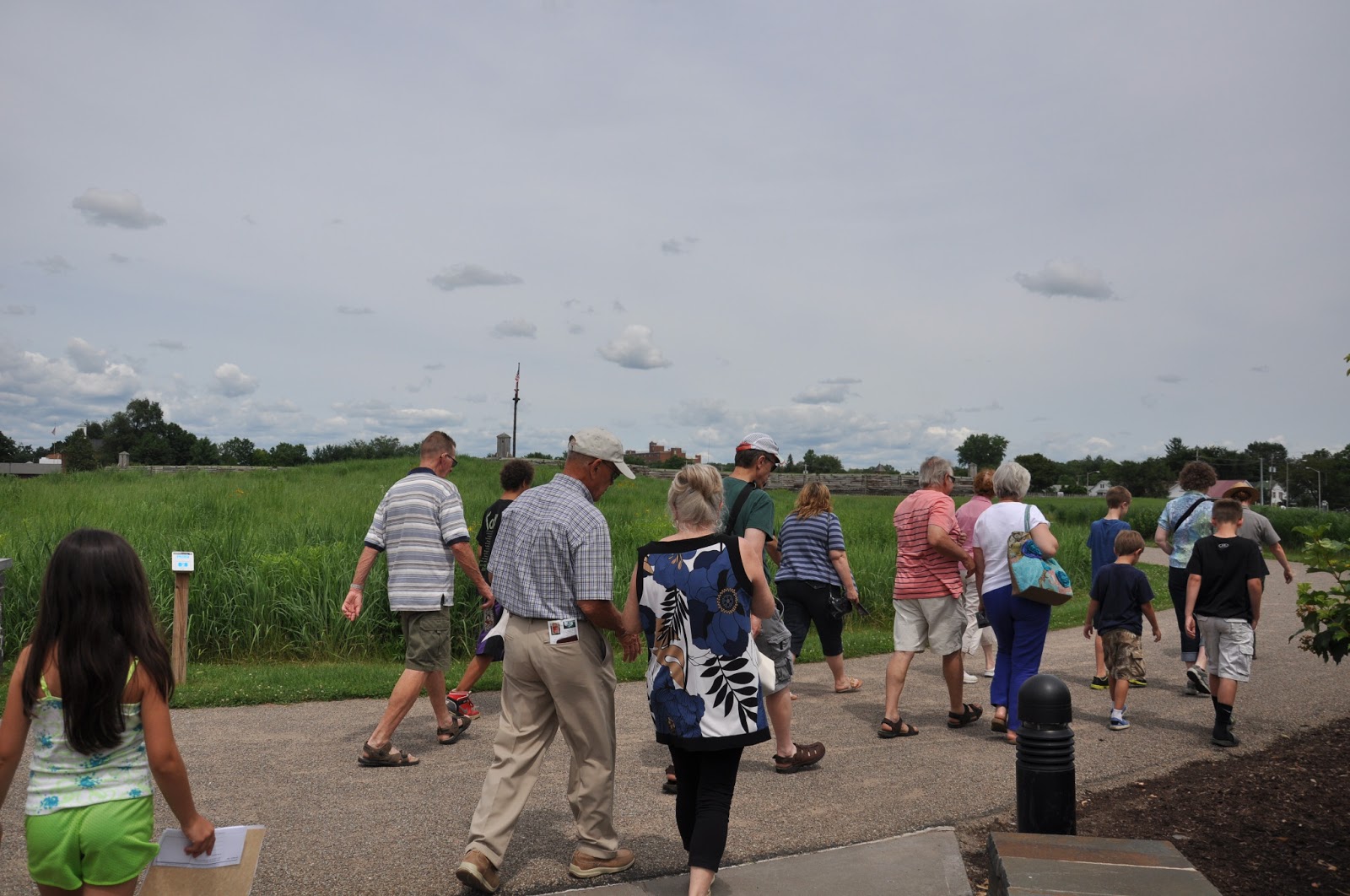
 At 2pm, we joined the ranger lead tour where Janet further explained the significance of the Oneida Carry.  After a quick pass through the Willett Center, we walked towards the new fort.


 Above the southwest bastion,  the US flag flew as it's predecessor did during the siege of 1777, claimed by some to be the  "first time the stars and stripes flew in battle". It was, of course, an early version, earlier even than Betsy Ross'  and might not even have any stars on it.


The new fort is a faithful, albeit partial, reconstruction of the original fort of which only a hearth remained. We learned from Janet the multiple layers of defense the fort had to protect against attackers - parapet,  fraise, ditch (which was then also used as added living spaces), cannons on the embrasure.


Encasement
Soldiers' Quarters: Casement
We explored the living quarters of the residents of the fort, from the very simple straw bunks for soldiers housed in the encasement to more comfortable accommodations for the officers.


Artillerymen's Quarters


Commandant's Quarters


-


What an enjoyable lesson in history it was. An must see for the locals and any history buff for that matter.

---------------------------------------------------------------------------------------------------------

References:

Fort Stanwix.  National Park Service

Fort Stanwix National Monument 1999.   National Park Service Cultural Landscapes Inventory.

Philip Schuyler.    The People of Colonial Albany

Fort Schuyler. Maritime College State University of New York.

Old Fort Schuyler . Utica NY. A Site on Revolutionary Day Road Trip

John Stanwix. Wikipedia.org