Sunday, August 2, 2015

Montezuma National Wildlife Refuge

On the north end of Cayuga Lake in the heart of the Finger Lakes Region lay a major resting area for migratory waterbirds as they journey to and from nesting areas in Canada.  Before the 1900's the Montezuma Marsh used to extend 12 miles north of Cayuga and was 8 miles wide. But after the construction of the dam at Cayuga's outlet and changes made during construction of the New York State Barge Canal, only a small portion of the marsh remained undrained.  In 1937, what is now the U.S. Fish and Wildlife Service purchased 6,432 acres of former marsh where the Civilian Conservation Corps started building a series of low dikes to hold water and restore part of the marsh.  The Montezuma National Wildlife Refuge was established on September 12, 1938 as a refuge and breeding ground for migratory birds and other wildlife. Now consisting of more than 7,000 acres, the refuge is carefully managed to ensure a suitable food mix for migratory birds along its 3,500 acres of diked pools as well as to ensure a healthy population of native wildlife in the surrounding wooded areas, grasslands and wetlands.

We started our visit at the Visitor Center in Seneca Falls where we got information about the refuge. We enjoyed viewing their exhibit, anticipating the wildlife that we would see on our tour.  It was hot and humid at that time so we decided to skip the walking trails especially after the mosquito warning from the staff.


We instead drove on the self-guided Wildlife Drive which took us along the eastern edge to the northwest part of the Main Pool. 


There were different kinds of birds alongside the road. We were able to see a number of great blue herons, lot of ducks (mostly mallards), Canada and snow geese, and a great egret. We would love to come here during the spring or fall migration when a great number of these birds stop by on their way to their breeding grounds.  The number of waterfowl supposedly peak in mid-November with about 50,000 geese and more than 100,000 ducks.  What a sight that would be!


Egret

Great Blue Heron

At the observation tower overlooking Tschache Pool,  a spotting scope allowed us to watch more ducks and snow geese.  They were too far away to photograph with my camera's 300m lens.  We were hoping to see some bald eagles since one of the 6 active bald eagle nests was supposed to be on Tschache Pool but without success.  We could not proceed to the other known site on Armitage Road because of a bridge closure on Rt. 89. 

The Montezuma National Wildlife Refuge holds the distinction of being the first in North America to use "hacking", a falconry technique to release young bald eagles to the wild.  Between 1976 and 1980 when the program was relocated to western new york, the bald eagles restoration program, using this hacking technique, released 23 bald eagles from the refuge.  Some eagles returned to the refuge which now has about 60 eagles. 

In search for the bald eagles, we went to Mud Lock, where Lock 1 of the Cayuga-Seneca Canal is located where we saw the snow geese mingling with some Canada geese.


Across the canal, there was a large nest on top of a utility tower which appeared to be ospreys rather than bald eagles although they were too far away to be appreciated.    

We returned to Route 90 just east of the refuge's boundary where we had earlier noticed similar nests.We saw 3 nests on top of utility towers at least 2 of which had ospreys on or near the nest.  We were particularly entertained by the pair below. 

                                                                           
We watched and watched until they finally flew away, a fitting ending to our visit to the Montezuma National Wildlife Refuge.


Tuesday, May 28, 2013

Ager's Falls


What a beautiful day Memorial Day turned out to be.  After the week's cold, rainy spell which had lasted until mid-day Sunday, we were ready to go out and do some exploring.  Our destination was Ager's Falls.

Proceeding on Route 12 North, we turned right on E. Main St. in the village of Port Leyden, about 14.4 miles from where Rt 12 had separated from Rt. 28.

From the bridge, we noticed what looked like a cormorant on a rock in the middle of the Black River.


Lyonsdale Falls


We eventually reached Lyons Falls where we noticed a bridge by the Burrows Paper Mill on Lowdale Road. Directly under the bridge is Lyonsdale Falls.


Moose River Trail
Going back to Lyonsdale Road, we went a mile and reached the trailhead for the Moose River Trail leading to Ager's Falls.  The trail went through the woods, going alongside the river throughout it's course.  It was a lovely hike, although some parts were soggy and what used to be boards or boardwalk over these parts are now rotted.


We hiked alongside some rapids that make the Bottom Moose one of, if not the most important whitewater run in the state. After all the rains the previous days, the rapids certainly looked intimidating. We would have loved to watch the coming Moose River Race. Alas, our camp would be closed by then.

After a mile,  we reached Ager's Falls. This has been described as "one of the easiest 18 footers around".  Really?  Well, in the not too exact science of whitewater rapids classification which goes to Class VI, it is only Class IV.  Rapids along the bottom Moose goes as high as Class V.


Agers Falls


Ager's Falls is named after Joel W. Ager who was born in New Hampshire but came to Lewis County in 1840 to build a new paper mill. 

The Ager's Falls Historical and Recreation Area is owned and maintained by the Fortis US Energy Corporation. In addition to hiking, there are areas for swimming, picnicking and fishing.  There are even some very welcome, clean outhouses.  And, one does not need to hike to get there. 

  An access road on Lyonsdale Road (about 0.6 miles before the hiking trail) leads directly to the recreational area.  Thankfully, we missed the turn the first time we drove by it.  Otherwise, we might have missed out on the very pleasant hike along the Moose River Trail.


Tuesday, August 16, 2011

The Observation Deck on Moss Lake

We finally found the observation deck that missed on our first visit to Moss Lake.


From the observation deck, one can view almost the entire 115-acre lake.


Wildlife abounds on this lake. The most remarkable is a pair of ospreys that have nested on the island in the middle of the lake.


And the loons are not too shy to come close to the deck for good viewing.


Still, a good pair of binoculars would be most useful.


Sunday, June 26, 2011

The Skyfields on Jackson Hill

Our 3rd weekend at Kayuta and we're still waiting for that nice sunny day.  At least, we got a visit from this small red backed salamander, supposedly the most common salamander in this area. All the rain must have encouraged it to come out of its hiding place to go hunting.

During the brief respites from the rain, we were able to go on short walks around the camp and even go on a short canoe ride.

Desperate for something new to explore, we headed out towards Jackson Hill in search of a trail. About 2.1 miles after turning from Route 46, we found the parking lot for the Skyfields on Jackson Hill, one of the cross-country ski trail systems maintained by BREIA which is open for hiking and biking in the summer.


The trails are closed to the public on Mondays to Friday from 9am to 1:30 pm and on this drizzly Sunday morning, we had the trails to ourselves.


We started walking on the Hillside Trail hoping for a nice easy stroll but ended up going down towards the Telemark Field. We got our aerobic workout climbing back up.


The Skyfields Trail system is said to offer the "finest views and the most spectacular landscapes" of the 3 BREIA trail systems. Today was not the day to enjoy these views. With a lot of area to cover, as seen on the map, we will have to spend more time here in the future...when it's not raining.

Friday, October 1, 2010

Turtles Galore

After getting used to seeing turtles on Culver Brook, I thought I'll never get excited about seeing turtles again. Until my husband and I took that canoe ride beyond the Kayuta Lake Dam.

Just before or at the beginning of the Forestport Reservoir, we could see a bunch of tree stumps on the west side of the water.  A majority of the stumps was occupied by sun-bathing painted turtles.  Overall, we must have seen at least 30 of the creatures.


Monday, August 30, 2010

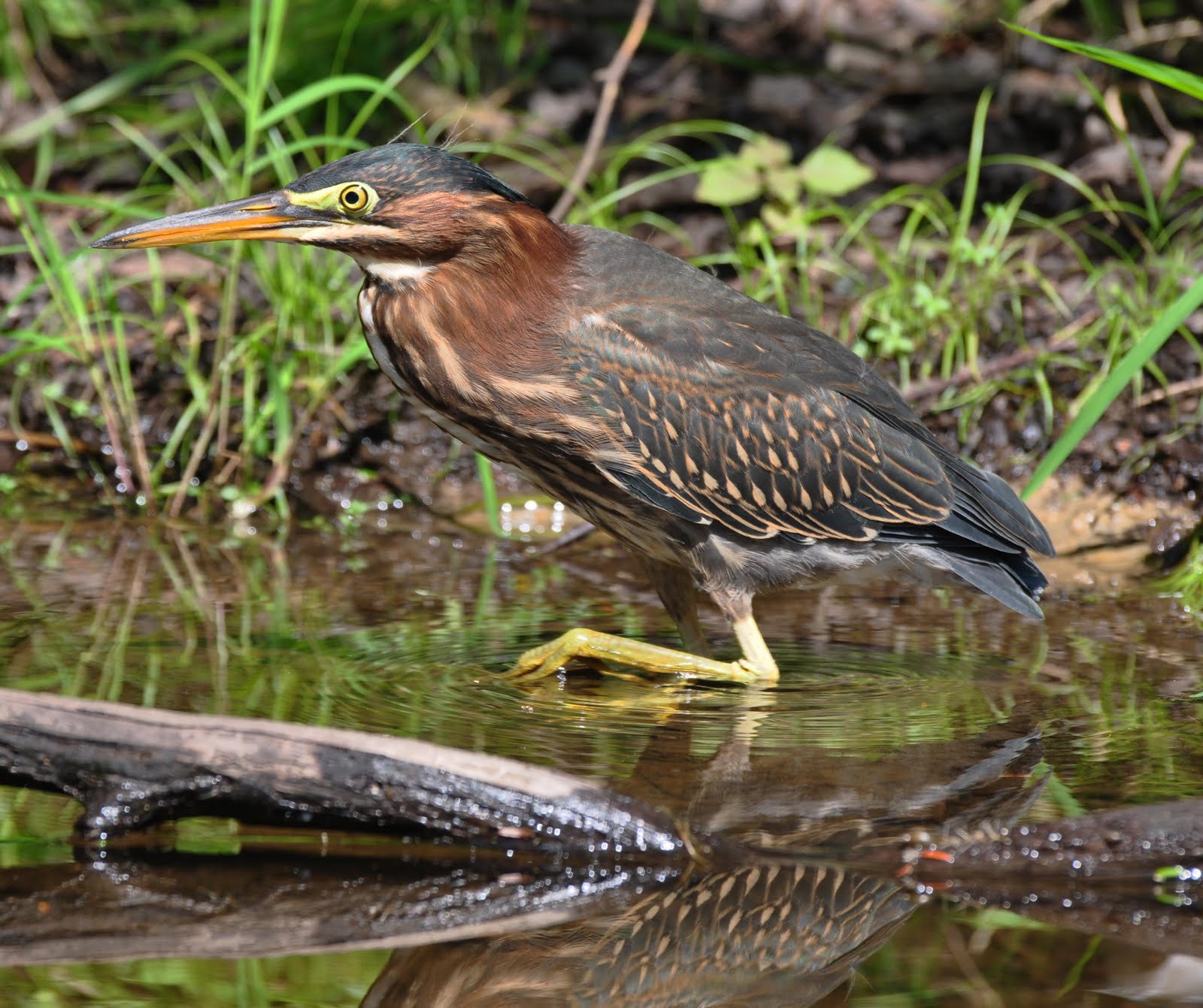
A Green Heron on Kayuta Lake

What a treat it was to see this green heron while canoeing on Kayuta Lake.  This small, stocky wading bird is commonly seen in swamps and marshes, along creeks and streams, lake edges and pastures.  It did not seem perturbed by our presence as it nonchalantly went about foraging for its food.

Monday, August 23, 2010

We have hummingbirds, finally

After last year's unsuccessful attempt to attract hummingbirds, we decided to change tactics.

First, we got a new feeder which we hang away from the first one.  Lo and behold, the following day, we had hummingbirds.

Next, we moved our original hummingbird feeder, a pretty glass one, next to the new feeder.  And indeed, after a day, a hummingbird was seen feeding from it.  But the next day, we saw the hummingbird spitting out the sugar solution and never came back to use the glass feeder.  For some reason, the solution must have gotten rancid which supposedly can happen more quickly with glass feeders which get hotter under the sun than a plastic one.


So, we just moved the plastic feeder to the original spot where we can easily view the hummingbirds whenever they come.  And what a joy they have been since then.


Wednesday, August 11, 2010

A Snake Encounter on Kayuta Lake

Poisonous snakes are present in New York state. Although there are many biting snakes, only 3 of the 16 native species carry venom that pose a danger to human life. We nevertheless were a little wary when we saw this little creature slithering about our deck.


Is it poisonous? Supposedly, poisonous snakes have vertical pupils which this did not have. Actually, it was only a common garter snake (Thamnophis sirtalis). Characteristically docile, its bite could nonetheless cause swelling and rash in humans, a reason to stay clear of its way.


Ref: Snakes of New York State

Saturday, July 24, 2010

Heron on Kayuta Lake

7/24/2010

We saw a heron today.  I guess that's nothing special at Kayuta Lake.  The amazing thing was that it allowed me to go as close to one as I've ever been before (at least in the wild), about 10 feet away.


It was fun watching it walk, it's neck extending everytime it took a step.


Monday, May 31, 2010

Woodpecker Taps


The presence of woodpeckers can easily be recognized by the characteristic tapping sound they make as they look for insects on trees. This time, the tapping was more metallic in sound and so loud. This woodpecker was tapping on our circuit box attached to an outside pole.


It even looked back and seemed to say "Do you have any problem with this?"

Tuesday, May 18, 2010

Opening Day 2010


A beautiful mallard drake floated by as we gazed on the water with our beers in hand. Opening the camp is a chore we look forward to from the time we close it up in the fall. Saturday May 15 was a beautiful day to do so. Cool, partly cloudy but with no precipitation occurring, it was just the proper weather for the mandatory clean-up.

Sunday was even better. Sunny and warmer, it was perfect for just wading in the water. The lower water level, courtesy of Algonquin Power, which seems to be operational again, exposed more beach area around the camp. A dead fish at least 2 feet long floated in the water. Not a pretty site, but it just proved that there is indeed fish for the taking here. Our fishing licenses are ready.

Sunday, September 13, 2009

Turtles on Kayuta Lake

I just love watching the turtles on our lake. On a sunny afternoon, one can invariably find a number of turtles sunning themselves on partially submerged logs on one of bays on Kayuta Lake. Today, I spotted at least 8 turtles. Previously, they just seemed too quick to dive into the water as soon as I approached. More recently, they have been more tolerant of my presence.


These are probably painted turtles which are the most common of the New York state turtles.

As common as they are, it is probably still illegal to collect this wildlife specimen without the proper NY Department of Environmental Conservation permit. So, if anybody else enjoys herping, please just watch and enjoy.

Saturday, August 22, 2009

A Loon at Kayuta Lake

We went out on the canoe and kayaks with my cousin Meny and her husband Rudy this afternoon. Paddling through the mid portion of the lake, we saw the black head of a large bird just over the top of the water. It was sitting low in the water and had a long pointed bill unlike the common ducks we usually see. Then, it dove and disappeared only to appear again further out on the lake. It was a loon!!! Common in the Adirondacks, this was the first time we have ever seen a loon on our lake.

We crossed under the railroad trestle and proceeded to a cove on the right. After a considerable distance, we spotted a turtle on a tree stump. Going further, I spotted something swimming in the water that was definitely not a duck. A kayaker told us it was either a beaver or muskrat. He raced the animal down and shouted out "beaver"! On the way back we visited the turtle up close but of course it jumped off the stump just as I was about to take its picture.


The sky started to appear threatening just as we got back on the main body of the lake. We were padding full throttle when we heard a train whistle. We paddled as fast as would could towards the train bridge. About 5 minutes later a 6-car train crossed the bridge. As we approached the bridge, a bi-plane flew over the bridge from the other side. Passing under the bridge I saw the Loon again - it popped up out of the water just in front of my kayak. Appearing just as surprised as I was, it dove again and fortunately reappeared close enough for me to take its picture.


We made it back to the house with nearly an hour to spare before the heavens let loose. We all agreed that this was the best wildlife viewing paddling expedition we have ever had on this lake.

Thursday, September 11, 2008

Frogs and Toads


When you're in Kayuta Lake, it is just natural to come in close contact with frogs and toads - especially when you're with a kid who would not stop at anything to find one.


Below are some pickerel frogs we saw by the Kayuta dam. The pickerel frog (scientific name Rana palustris) can be identified by the "hand-drawn" squares on its dorsal surface. The squares can become confluent and appear like rectangles. They also have prominent ridges seen as the continuous white lines on its back.


We found this green frog at the Black River Canal towpath in Boonville. The northern leopard frog, which can also be brown in color, is characterized by the dark circular spots irregularly found throughout its body. Two light colored dorsolateral folds can be seen between the back and the sides.


We almost missed this toad hiding among the rocks by the dam. Toads are technically also frogs since they belong to the same order (Anura) of amphibians. (Click here if you don't believe it.) They can be distinguished from true frogs like the leopard and pickerel by their sturdy bodies, dry and warty skin and the presence of poison glands behind their eyes. I believe this is an Eastern American Toad, but I could be wrong.

For more information on frogs and toad, check out this identification guide from the Northern Prairie and Wildlife Research Center.

You can see more images and listen to the sounds of these frogs in a page from the Monocacy and Catochtin Watershed Alliance website.